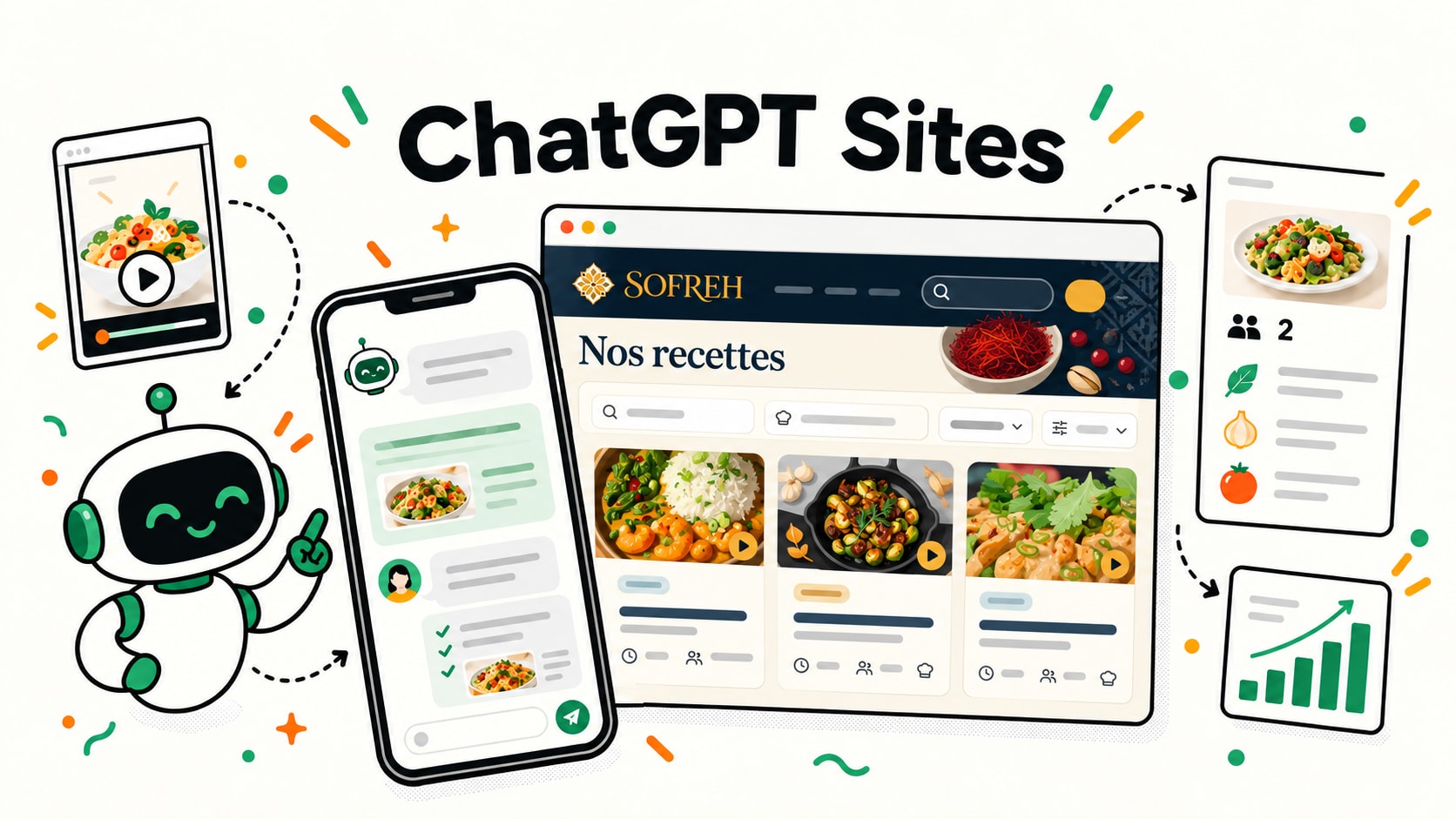
I tested yet another AI tool: OpenAI's ChatGPT Sites. It let me build and publish Sofreh, a shared recipe website, by talking to AI directly from my phone.
With ChatGPT Sites, OpenAI is taking on solutions such as Claude Artifacts and Lovable for creating websites and lightweight apps with AI. The promise is appealing for people who have ideas but lack the technical skills to build them: describe what they want to create, then refine it by talking to AI.
The result goes beyond a simple AI-generated page: this project has user accounts (with sign-in through ChatGPT), persistent data in a database, and features designed for more than one user. But the iterations also revealed some of the limitations of these tools.
Here is what I learned from the experience.
ChatGPT Sites in a Crowded Market
ChatGPT could already generate the code for a website. With ChatGPT Sites, OpenAI adds the environment needed to build it, refine it, and publish it easily from ChatGPT.
The idea is not new. Claude Artifacts, Lovable, v0, and Replit already let people create websites and lightweight apps with AI. I had previously tested Lovable to build a website for a local business.
The main appeal of ChatGPT Sites is its integration into ChatGPT, a tool many people already use. The official OpenAI documentation provides more details about the feature.
It does not revolutionize the space: Lovable remains more comprehensive. However, native integration into ChatGPT is an advantage, particularly in terms of cost. ChatGPT Sites is included with eligible ChatGPT plans, subject to plan-specific limits.
Sofreh: Finding Recipes Easily
To test ChatGPT Sites, I wanted to start with a real need rather than a demo idea.
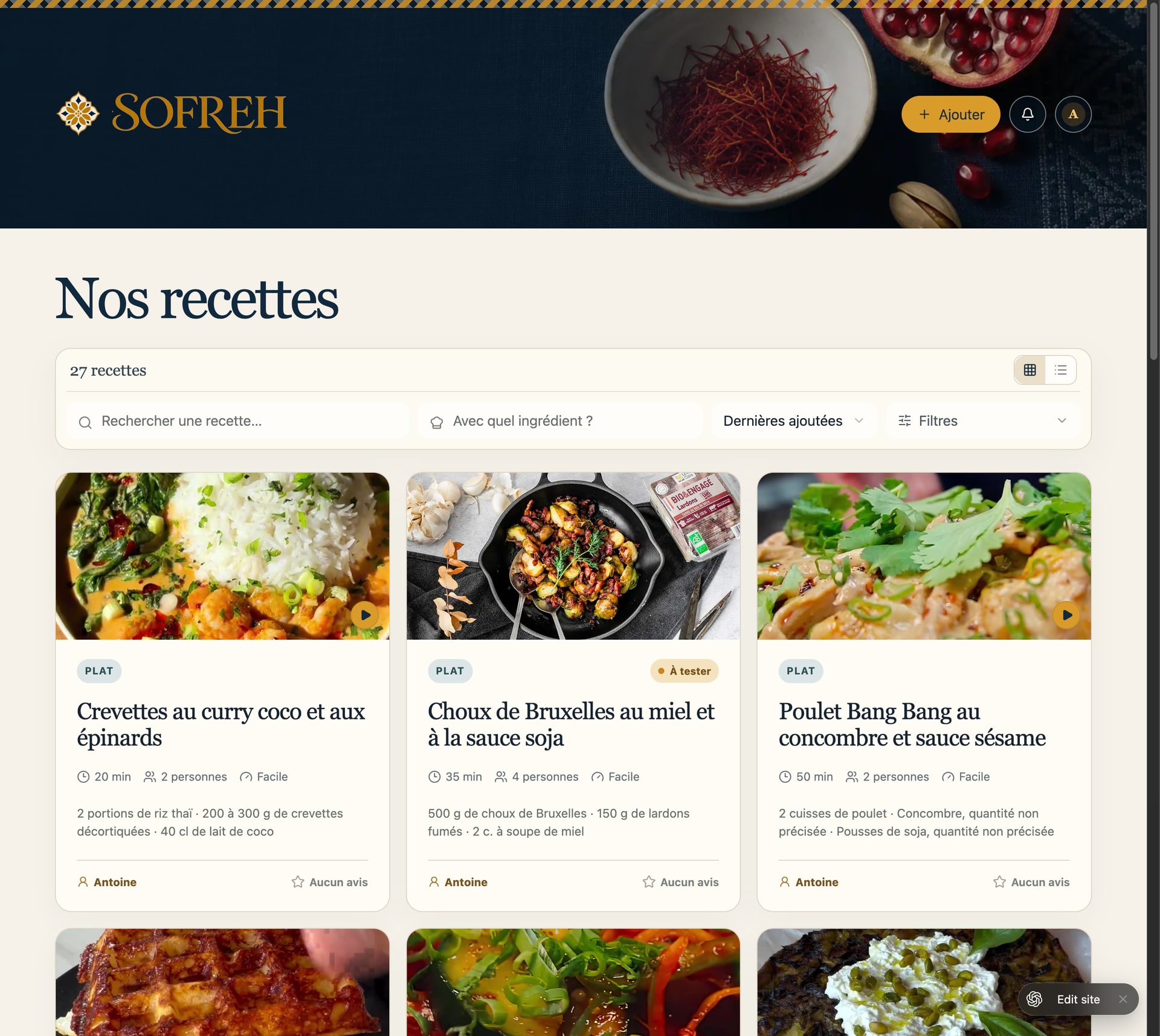
My partner and I save recipes in all kinds of places: links in Apple Notes, but mostly videos on Instagram, TikTok, or YouTube. Ideas for meals pile up and eventually disappear among our saved posts.
The idea behind Sofreh was to bring everything together in one place that we could share. We wanted to find recipes again, see which ones we still needed to try, and publish our reviews after cooking them.
I did not prepare a detailed specification for this project, as I would for a professional one. I started with a few sentences in ChatGPT Work. The product became clearer as we used it: search, filters, statuses, reviews, videos, notifications, and a queue of recipes to add.
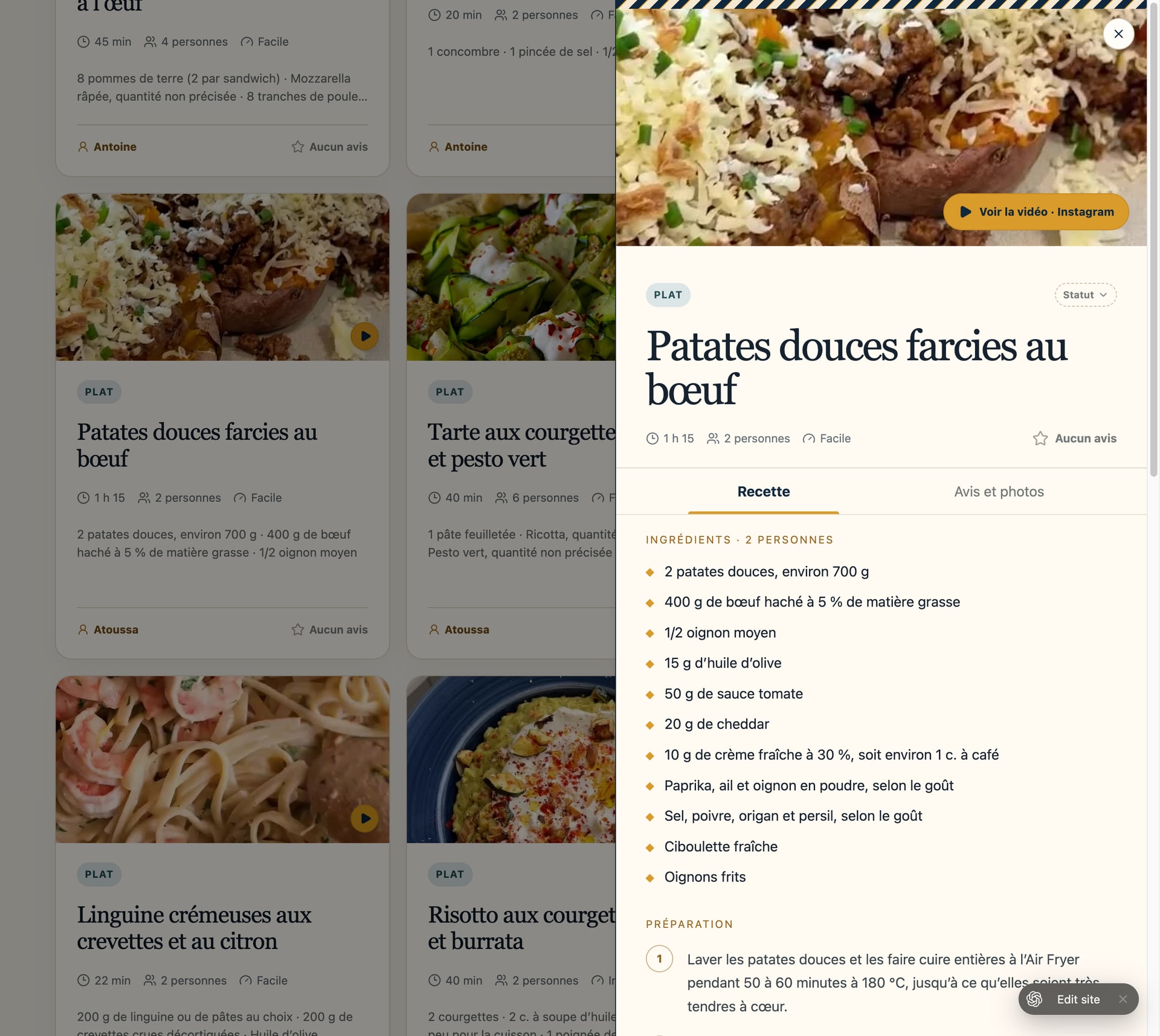
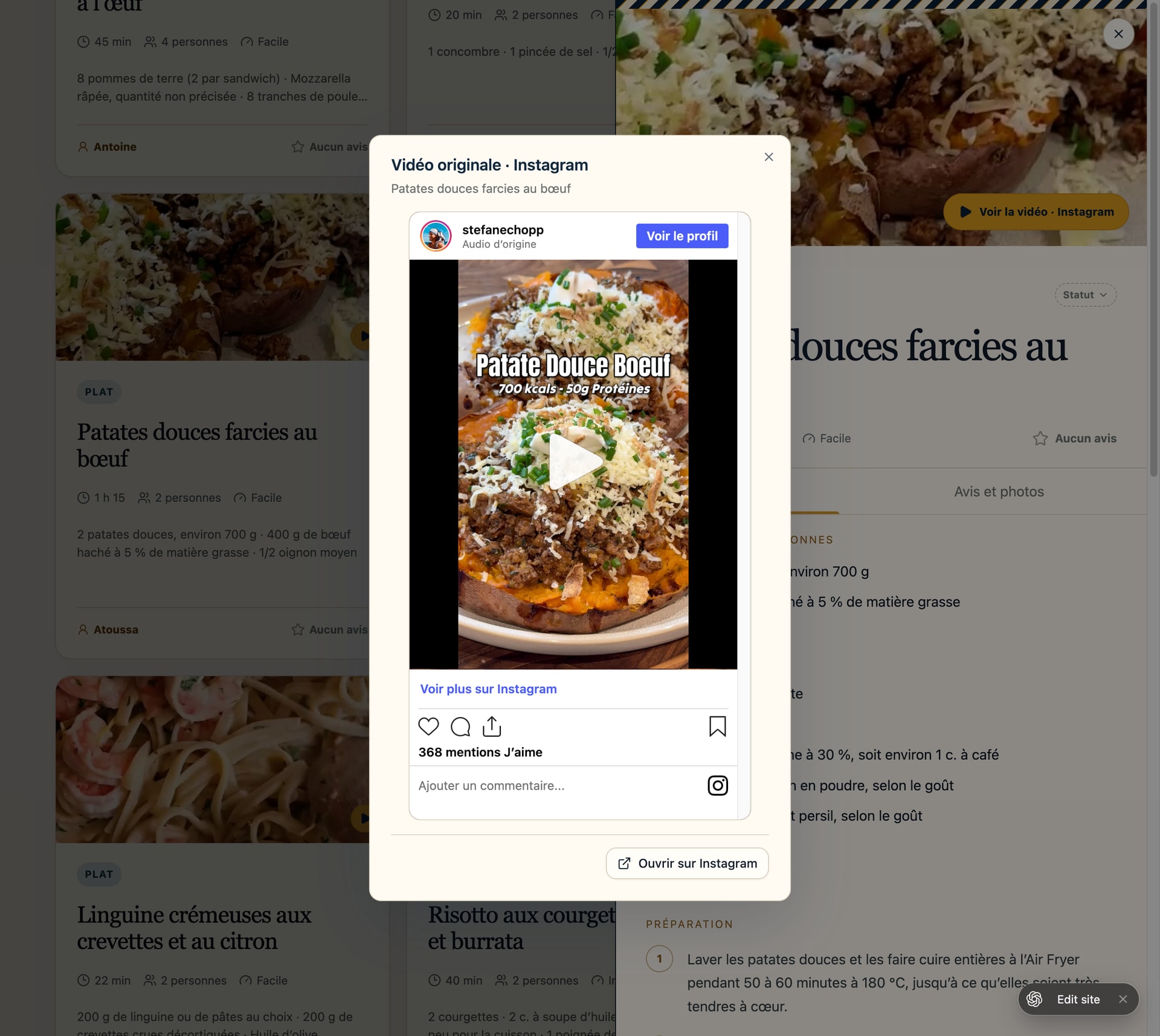
In practice, a recipe can come from a website link or an Instagram, TikTok, or YouTube video. AI extracts the information, structures the recipe page, and prepares a version for two people when that makes sense. Once the recipe has been added, we can change its status, publish reviews with photos, and talk in a comment thread.
As with Music Discovery, my website for listening to albums again, the project came from a personal desire, not only from wanting to test an AI tool.
The website is available at sofreh-recettes.emerika13.chatgpt.site.
As we added more to it, the recipe book became a website that we both use, rather than just a demonstration of what AI can generate.
Building a Website Through Conversation, Even From a Phone
I created the project from my phone, in the ChatGPT app using Work mode. I explained my idea, answered a few questions, reviewed the first version, and then requested changes.
The website was not built from one perfect prompt. It evolved message by message. I requested a more compact view, reworked the filters, and chose to open each recipe quickly in a side panel while keeping a real, shareable URL, among other changes.
This is where the experience becomes interesting for a non-technical person. They do not need to know how to code a filter or a page themselves. They can describe the result they expect, then explain what they want to improve.
However, decisions still have to be made: what information to display, which journey to prioritize, what deserves a new feature, and what would make the product unnecessarily complicated. Conversation makes development easier, but it does not replace product design.
From Conversation to a Usable Website
Once a version is ready, ChatGPT Sites publishes it at a chatgpt.site address. I could send the link to my partner and let her use the recipe book without separately configuring hosting or a deployment process.
A dashboard in ChatGPT then provides access to the website's analytics, data, and settings. It is simple, but enough to keep an eye on the project.
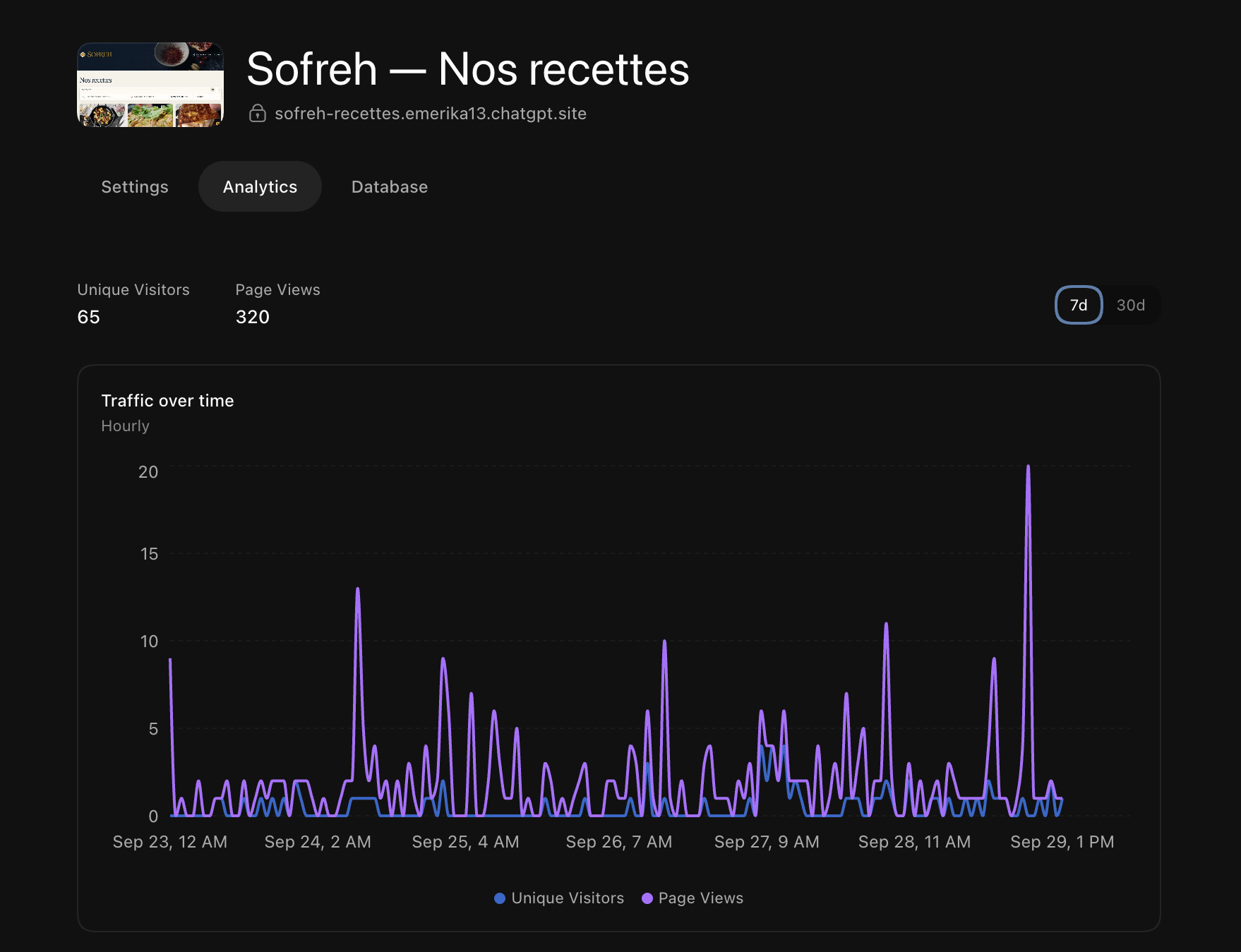
ChatGPT Sites is still in beta, with usage limits that should be checked before relying on it for an important service.
A Website That Works Is Not Necessarily Well Built
The website was live and the main features were in place. But as we added more recipes, actual use revealed some problems.
SQL Queries That Slowed Down the Homepage
As the catalogue grew, the homepage began to slow down. When I requested an audit, I discovered that the website was running one additional SQL query for every recipe displayed.
It retrieved the list, then fetched additional information one recipe at a time. The more recipes it displayed, the more queries it ran. The interface looked fine, but the way the data was retrieved slowed down the page.
As I made new requests, AI had added features without revisiting the overall data-fetching approach. I had to explicitly request a performance audit and then ask it to fix the problem.
This is one of the main limitations of AI-assisted development. Without an explicit request for refactoring or a code review covering security, performance, and similar concerns, AI can miss problems that a developer would be more likely to anticipate.
SEO and Social Sharing Previews Were Overlooked
I encountered another problem when sharing recipes. They had their own URLs, but the titles, descriptions, and images displayed when someone shared a link were not configured correctly.
I had to request the addition of Open Graph tags, as well as a sitemap and recipe-specific structured data.
ChatGPT Sites could do it, but I had to ask.
For our personal recipe book, this was not a blocker. For a website intended to be found through Google or shared on social media, these details matter from the first version. You still need to know that you should ask for them.
This is why these generators remain easier and more effective to steer with technical, or at least product, knowledge: I knew what to request and what to verify.
Building Gets Easier, but Verification Still Matters
Overall, my experience with ChatGPT Sites was positive. Sofreh has become a small but real web product that we use.
This is the main promise of these tools: allowing someone to start from a need, test an initial solution, and evolve it without mastering every technical detail.
My technical background nevertheless helped me understand why the page was slow, request an audit, and check the SEO. A non-technical person can tell when a result does not meet their expectations. Identifying the cause and verifying the fix remains more difficult.
ChatGPT Sites therefore makes it possible to create a project from your phone, directly within a conversation. It is an excellent starting point and a great way to test an idea quickly, but when the project becomes more serious, knowing what to request and verify can help produce a more reliable result.
This is also what I do as a Product Engineer: turn a need into a product, steer the iterations, and review what AI builds.
What small personal tool would you want to create if you could start directly from a conversation?
📌 Do you have a product idea or an AI-built prototype that you want to make more reliable? I can help from initial framing through implementation with my Product Engineering services.
Further Reading
- OpenAI, creating and managing ChatGPT Sites.
- OpenAI Academy, an introduction to ChatGPT Sites.
- Anthropic, building and sharing apps with Claude Artifacts.
- Lovable, publishing and hosting applications.
- Tom's Guide, another hands-on review of ChatGPT Sites.