Last week, I tested Google's new IDE, Antigravity, to develop an internal tool I sorely needed.
Image optimization is crucial for fast-loading sites, user experience, and of course, SEO.
However, for lack of a free, simple, and truly effective tool, I didn't do it systematically...
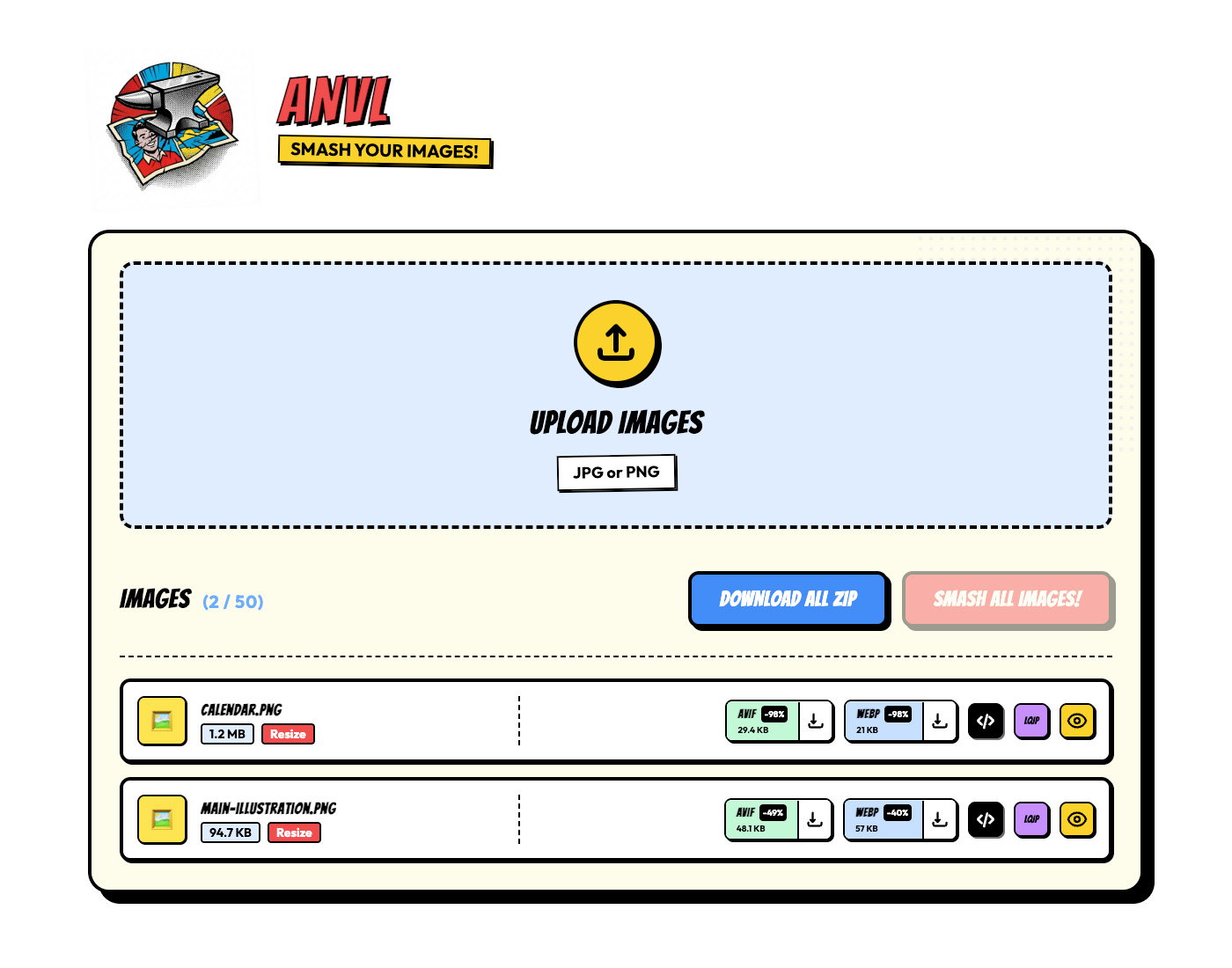
But that was before, because I took advantage of the Antigravity test to develop ANVL, my own image optimization tool, using the power of "vibe coding" with AI.
The Magic: Creating a Functional Tool in Minutes
To create this tool, I didn't write a single line of code to start.
I launched Antigravity and wrote a simple prompt specifying my tech choices (Nuxt for the front-end) and the application's goal. The result was immediate:
- In a few minutes, I had a functional first version.
- The code was clean, the structure in place.
The downside? The design.
It was "pure AI style": a violet interface, very clean, but soulless. It looked like every other automatically generated site.

Antigravity’s Strength: Using Nano Banana Pro
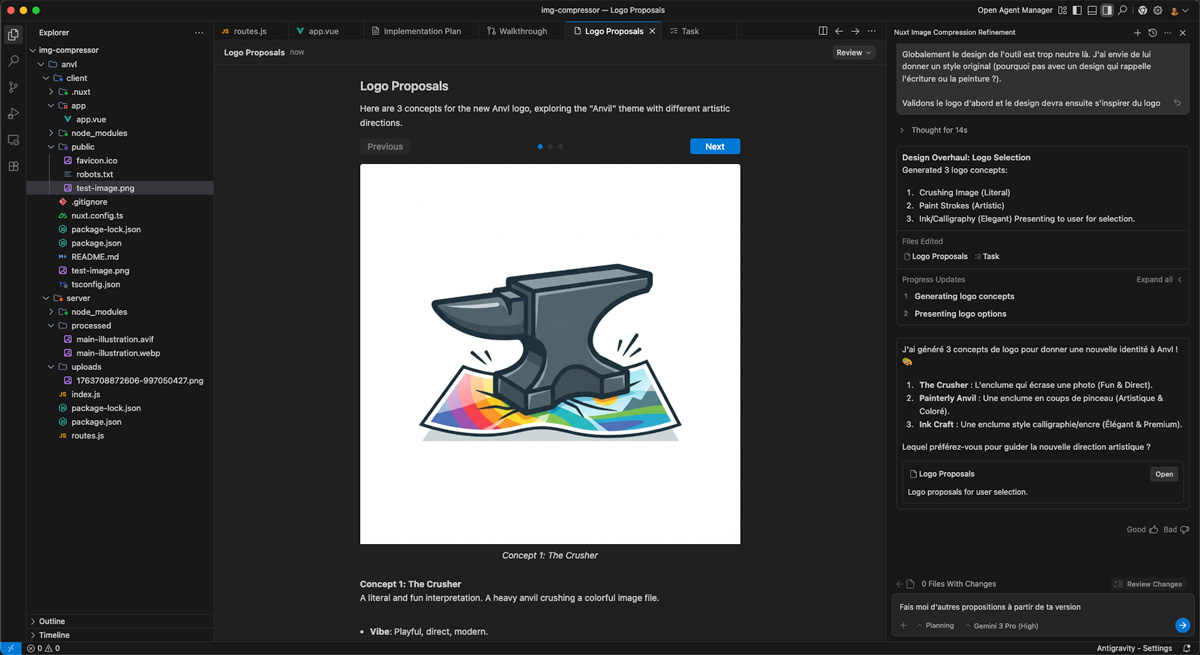
This is where I wanted to test one of Antigravity's major strengths: the native integration of Nano Banana Pro, Google's AI for image generation.
Instead of looking for inspiration elsewhere, I directly asked the IDE for several logo proposals based on my concept: an anvil crushing an image to compress it.
- The AI proposed several variants, including a Pop-art style logo that I immediately loved.
- I then asked Antigravity to completely overhaul the interface design, inspired by this graphic style.
We went from a bland tool to a vibrant interface with a real visual identity in just a few minutes.
The "Killer Feature": Native Chrome Integration
Beyond the design, what blew me away was the native integration of Chrome within the IDE.
Unlike a classic editor, Antigravity's AI can:
- Directly view the result of its creations in the integrated browser.
- Check if features are working.
- Test the tool as a real user would.
It's a striking glimpse into the future of development. As for the rest, the tool remains a VSCode fork (it looks exactly like Windsurf, which I use), so you won't feel out of place.
Plus, Google offers credits to use Gemini 3, but also Claude, so I was able to code my tool for free, even if the limit remains low for now.
Result: ANVL, My Image Optimization Tool
In the end, I created the tool I now use for all my projects. A perfect tool to easily generate my optimized images without wasting time.
I continued adding features, always via AI, to reach this result:
- Batch Resizing: Process up to 50 images at once.
- Automatic Conversion: Transforms JPG/PNG into modern formats (AVIF and WebP).
- Smart Compression: Drastically reduces file size without sacrificing quality.
- Comparison: A "Before/After" slider allows you to verify that visual quality hasn't been degraded.
- Resizing: Ability to resize your JPG/PNG image before conversion, and download it at the new size.
- Ready-to-use Code: Generates HTML
<picture>tags ready to be pasted. - LQIP: Automatic creation of tiny blurred placeholders for progressive loading.
- Security: Everything happens on the client/local server side; no data is sent externally.
Conclusion
Antigravity clearly has potential, especially thanks to its integrations with the Google ecosystem (Chrome and Nano Banana). It’s a new step towards removing the friction between idea and realization.
If you would like to optimize your images (and you should!), I'm making the tool available for free.
👉 You can download ANVL on my Github account
And if you need a hand with technical optimization or your site's SEO, feel free to contact me!